0%

On September 15, 2026, TypeSafe AI released an AI model called Jev. Rather than pushing the boundaries of general-purpose model capabilities, Jev carved out its own niche in decision-making and judgment. While everyone else is racing to build better generative models, TypeSafe AI took a completely different approach—focused squarely on delivering fast, accurate, and structured decisions for production systems.

Jev is far more than just another fast, cheap classifier. Its real question is: Can AI output skip natural language entirely and become typed values that flow directly into program control logic? That’s why I see Jev as a new kind of AI infrastructure: a Decision Model.

Read more »

1. Where the Problem Starts

Anyone who’s used OceanBase has hit this scenario: tables partitioned by time range require partitions to be created manually in advance. Forget to create a new partition, and data writes fail immediately with a “partition not found” error. Create too many partitions upfront, and empty partition metadata becomes a maintenance burden. For tables like logs and order transaction records — data with a clear lifecycle — DBAs also need to periodically clean up expired partitions. One mistake and you risk data loss or production incidents.

Starting from V4.3.5 BP2, OceanBase introduced dynamic partitioning to completely remove “partition creation and deletion” from the DBA’s daily operations. An important clarification upfront: dynamic partitioning is not an entirely new partition type. It’s an automated management layer on top of RANGE / RANGE COLUMNS partitioning. Understanding its design logic and applicable boundaries is more valuable than just memorizing the syntax.

Read more »

1. Background

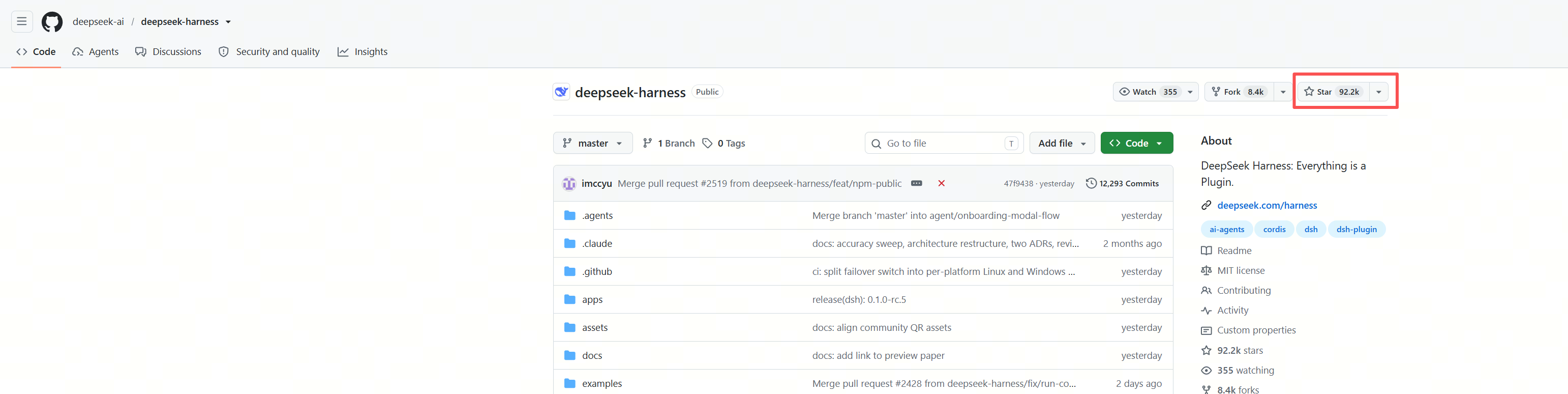
On August 13, 2026, DeepSeek officially open-sourced the Harness developer preview. The project broke 20,000 stars on GitHub within an hour of launch, then surpassed 920,000 stars the following day — a massive impact.
alt text
From forming the Harness team in May, to opening internal beta testing in July, to fully open-sourcing under the MIT license in August — the entire process took less than 3 months. This pace signals that DeepSeek isn’t just releasing a new tool here — it’s making a directional shift in product strategy.


Read more »

On July 10, 2026, OpenAI released GPT-5.6.

The one core takeaway: large language models are transitioning from chatbots to agents that get work done. Previously, you asked questions and got answers. Now, you give it a goal, and it plans the steps, calls tools, coordinates multiple Agents in parallel, and completes the task. On the efficiency front, GPT-5.6 delivered solid numbers across coding, knowledge work, cybersecurity, and science — token usage and costs are dropping while task completion rates are rising.

Read more »

1. Component Overview

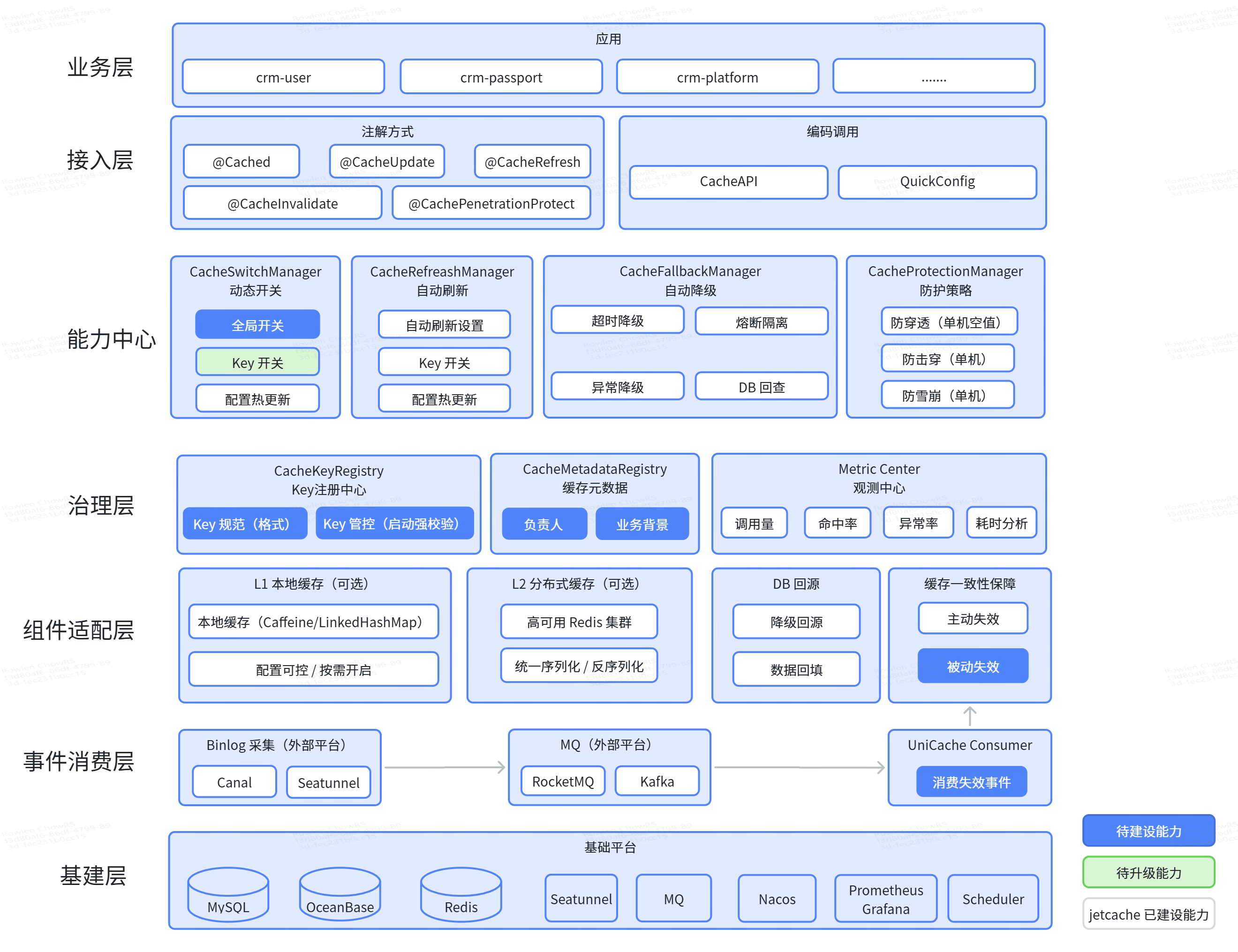
JetCache is a general-purpose cache access framework open-sourced by Alibaba (source). It does one thing: with a unified Cache<K, V> interface, it seamlessly combines local in-memory cache with remote Redis cache, then provides standard cache protocol integration through both annotations and API — letting business code use caching in the most concise way possible.

Compared to Spring Cache, JetCache’s core advantages:

Capability Spring Cache JetCache
TTL (time-to-live) Not natively supported, requires customization Natively supported — write expire directly on the annotation
Two-level cache Not supported Natively supported CacheType.BOTH (local + remote)
Auto cache refresh Not supported Supported @CacheRefresh with globally unique distributed refresh
Penetration protection Not supported Supported @CachePenetrationProtect
Distributed lock Not supported Built-in tryLock / tryLockAndRun
Async API Not supported Supported (truly non-blocking with Lettuce client)
Stats & monitoring Requires third-party Built-in hit rate, load count, and other statistics
Update/delete cache annotations Exists but limited @CacheUpdate / @CacheInvalidate with SpEL support

alt text

2. Core Concepts

Read more »

1. Component Overview

JD-HotKey is a real-time hot key detection and caching middleware open-sourced by JD.com (source). It does one thing: in high-concurrency scenarios, it automatically discovers hot keys and pushes them to every application node’s JVM memory within milliseconds, so hot requests are served directly from local memory instead of hitting Redis or the database.

Classic scenario: a celebrity suddenly announces something, and a flood of requests hits the related products. You had no way to predict which product ID would go hot. A Redis node gets hammered by these requests and its CPU spikes — this is a textbook unpredictable burst hot key.

That’s where JD-HotKey comes in: it automatically detects these hot spots, mirrors the data into every application server’s local memory, and subsequent requests are served straight from memory — RT drops from tens of milliseconds to under 1ms.

Compared to using a local cache directly (like Caffeine), JD-HotKey’s core advantages:

Capability Caffeine Local Cache JD-HotKey
Hot key detection Manual configuration — you need to know which keys to cache upfront Automatic detection — determines hot keys based on real-time access volume
Dynamism Static, stays once configured Automatically joins/exits hot status, releases memory when cold
Multi-node consistency Each node is independent, unaware of others Global unified detection, all nodes synchronize
Use case Known high-frequency data (dictionaries, configs) Unpredictable burst hot keys (flash sales, trending searches)
Deployment complexity Low (pure SDK) Medium (requires etcd + worker)
Hot user / hot endpoint detection Not supported Supported (not limited to keys — endpoints and users too)

In short: known hot keys are fine with local cache; unpredictable hot keys need JD-HotKey.

2. Core Architecture
Read more »

Background

When a system evolves from a single Agent to multi-Agent collaboration, communication design becomes the deciding factor between success and failure. Once the system is running, the biggest challenge is no longer individual Agent capability — it’s how efficiently and accurately information flows between Agents. A typical review task passes through an average of 4 Agents in sequence, and any misunderstanding at one stage gets amplified downstream.

Communication design determines whether a Multi-Agent system collaborates efficiently or works at cross purposes. A single Agent is like a programmer working alone — no matter how skilled, there’s a ceiling. A team of Agents needs a communication protocol: who reports to whom, what format they use, and how failures are handled.

This article breaks down Multi-Agent communication across three dimensions: topology (who talks to whom), mechanism (how data flows), and protocol (what format they use). Then it analyzes failure modes and cost control strategies from real engineering experience.

Read more »

Over the past 50 years, human-computer interaction has evolved from CLI to GUI to Web. Shopify CEO Tobi Lütke recently reposted something that drew my attention to an experimental product called flipbook.page. It’s described as “a fully on-demand, real-time-generated infinite visual browser.” The core idea: every page you see is an image generated in real time by AI — no HTML, no CSS, no JavaScript. Everything is pixels.

Read more »

Background

When I was researching Chrome DevTools MCP previously, the core problem it solved was letting AI control a browser. But that approach had inherent limitations: you had to configure an MCP Server, depend on Chrome’s debug port, and write a separate adapter for each platform.

OpenCLI reimagines this from scratch, and goes further. It doesn’t just let AI control a browser — it turns any website into a standardized command-line tool. With 22K+ stars on GitHub, it’s clearly hitting a real need.

This article covers three things: what OpenCLI is, how its architecture is designed, and — the most important part — how to use it within Code Agents like Claude Code.

Read more »

Background

Every day, the routine goes: open your phone, scroll through Weibo trending, Zhihu hot list, Douyin trending, Toutiao — two hours gone, and maybe three to five items were actually useful. The rest is clickbait headlines, marketing fluff, celebrity gossip, and whatever the algorithm decided you might be interested in. Platform algorithms hijack your attention — the content you want to see is buried, and the content you don’t want is inescapable.

TrendRadar solves exactly this problem: it aggregates trending topics across the entire internet, filters them by keywords you define, pushes updates to your phone on schedule, and can even have AI analyze the trends and sentiment behind the headlines. It shifts you from passively receiving algorithm recommendations to actively consuming what you care about.

Read more »