On September 15, 2026, TypeSafe AI released an AI model called Jev. Rather than pushing the boundaries of general-purpose model capabilities, Jev carved out its own niche in decision-making and judgment. While everyone else is racing to build better generative models, TypeSafe AI took a completely different approach—focused squarely on delivering fast, accurate, and structured decisions for production systems.
Jev is far more than just another fast, cheap classifier. Its real question is: Can AI output skip natural language entirely and become typed values that flow directly into program control logic? That’s why I see Jev as a new kind of AI infrastructure: a Decision Model.
1. TypeSafe AI’s Background and Positioning
TypeSafe AI was founded by three co-founders. CEO Diogo Almeida is a former OpenAI researcher who worked on reinforcement learning and the early development of ChatGPT. CTO Erik Spock Gafni and COO Sasha Sheng also came from OpenAI. The team went into stealth mode after founding in 2024 and didn’t surface again until September 2026, when they unveiled Jev.
TypeSafe positions itself as building “machine-native AI.” Current large models are obsessed with reasoning and generation—trying to build ever-more-powerful brains to tackle tasks. But TypeSafe flipped the script: all that effort LLMs spend generating perfect responses is really just for human consumption. Yet AI’s real customers are engineering systems, and those systems don’t need elegant prose—they need fast, accurate, structured decisions. Take a customer support ticket: the system doesn’t care about a detailed explanation of why the ticket should route to refunds. It just needs {"department": "refund", "confidence": 0.93} so it can execute if (confidence > 0.9) { routeToRefund(); }.
There’s a deeper insight here: current AI systems are overconfident. Human readers can take model outputs with a grain of salt, but in automated pipelines with no humans in the loop, overconfidence cascades into errors. Jev addresses this by returning typed decisions with probabilities.
The timing matters too. Agent systems are evolving from single-turn Q&A to multi-step execution. Multi-step execution means massive volumes of high-frequency, low-latency decisions—classification, routing, gating, validation, risk detection, tool selection. Hand all of that to generative LLMs and you’ll hit cost and latency walls fast. TypeSafe’s philosophy is that AI capabilities need to be layered: some models handle judgment, others handle generation and reasoning.
2. Jev’s Design Paradigm
The traditional approach: ask GPT whether a user is requesting a refund, get back a paragraph of natural language, then have your code extract information, parse JSON, validate fields, handle exceptions, retry if needed, and finally execute business logic:
1 | Input → Model → Text → Parser → Business Logic → Action |
Jev compresses this pipeline:
1 | Input → Decision Model → 0.95 → if probability > threshold → Action |
Noul returns 0.95, which maps directly to an if statement. Choice returns "refund", which maps directly to a routing path. Score returns a position, which maps directly to a threshold check. These capabilities are essentially semantic functions: they wrap natural language understanding into typed interfaces that programs can call directly.
1 | GenerationModel: Prompt → Tokens |
Stateis structured input—a string, JSON object, or arrayQuestionis a natural language definition of what you’re askingTypedAnsweris a typed value with probability semantics
Generation models serve human consumers. Decision Models serve program control flow. That difference drives everything: training objectives, evaluation metrics, latency requirements, reliability expectations.
TypeSafe sticks with the mainstream LLM approach of token-by-token generation for slow, complex reasoning. Jev just takes input and returns a decision—no replies, no code, no explanations of its reasoning process. It currently only supports text input. Think of it this way: fast semantic judgment handles routing, gating, and classification; deep reasoning handles planning and generation. They complement each other.
3. Jev’s Three Decision Primitives
Primitives are the most technically interesting part of TypeSafe’s documentation. Each primitive pairs a question with a typed answer. There are three:
Choice answers “which one.” The answer comes from a known, unordered set of options: which team handles the ticket, what document type this is. You provide the option list and descriptions, and the model returns the selected option, the full probability distribution, and a confidence score. It’s essentially P(class | state, question), but the key difference is that the classification task is defined at runtime, not baked into model parameters. The same Jev instance can do ticket classification, intent classification, risk classification—no retraining needed.
Score answers “how much.” The answer sits on a spectrum where you can describe what each position means: bug severity, customer frustration level. You define ordered levels, and the model returns a position on that spectrum (which can fall between levels), plus probability distribution and confidence.
Noul answers “yes or no.” The model returns a probability between 0 and 1—close to 1 means yes, close to 0 means no, close to 0.5 means uncertain. Noul has no separate confidence field because the probability itself carries both the answer and the certainty.
The selection logic is straightforward: use Choice when picking from a set, Score when measuring degree, Noul for yes/no questions. When both could work, prefer the one your code can act on directly.
Here’s a Python SDK example:
1 | from typesafe_sdk import Choice, Noul, Score, TypeSafeClient |
One request, three different question types, evaluated in parallel, returning three typed answers. Notice the Score of 0.23: the three levels appear to map to normalized positions at 0, 0.5, and 1, so 0.23 sits closer to “Calm.”
4. The Confidence Trap
The docs say: “If an intelligent system can’t honestly acknowledge uncertainty, it’s not trustworthy.” But to use confidence well, you need to understand three concepts:
- Probability: the model’s probability for a specific judgment, like P(refund) = 0.95
- Confidence: how concentrated the current probability distribution is
- Calibration: when the model says 90%, is the actual accuracy across many samples close to 90%? Only with good calibration can you treat probabilities as accuracy rates.
4.1 The Trap: The Confidence Field Isn’t Accuracy

TypeSafe calculates Choice confidence like this:
1 | confidence = (n × peak - 1) / (n - 1) |
Where n is the number of options and peak is the maximum probability. When the distribution is completely uniform (peak = 1/n), confidence = 0. When peak = 1, confidence = 1. It’s a linear normalization of peak, which is fine in itself. The problem is developers might write:
1 | if answer.confidence > 0.9: |
And expect that means 90%+ certainty. That’s wrong. The same confidence threshold maps to completely different accuracy rates depending on the number of options:
| Options n | confidence = 0.5 → peak | confidence = 0.9 → peak |
|---|---|---|
| 2 | 0.750 | 0.950 |
| 3 | 0.667 | 0.933 |
| 5 | 0.600 | 0.920 |
| 10 | 0.550 | 0.910 |
| 16 | 0.531 | 0.906 |
Two direct consequences:
- Confidence systematically looks less confident than it is. A perfectly calibrated model with 16 options: samples with confidence = 0.5 are actually about 53% correct, while with 2 options it’s 75%. If you plot confidence on a reliability diagram, you’ll get a curve that deviates from the diagonal—but that’s not because the model is poorly calibrated, it’s because you’re measuring the wrong thing.
- Thresholds don’t transfer. You tune
confidence > 0.5for a 3-option task, then add 10 options to Choice later. The risk profile has changed, but the number in your code hasn’t.
Also, confidence only uses peak and throws away information about the runner-up. The distributions [0.5, 0.5, 0, 0] and [0.5, 0.2, 0.2, 0.1] have the same confidence, but the first is a toss-up between two options while the second is a clear winner with noise. Very different business implications.
The right approach:
- Base calibration evaluation and threshold setting on peak probability (or the full distribution), not the confidence field
- For Noul, accuracy corresponds to
max(p, 1 - p) - The confidence field works for UI display or coarse monitoring, not for driving automatic execution
4.2 RLCD: Clear Concept, No Public Benchmarks
Jev uses RLCD (Reinforcement Learning for Calibrated Decisions). Unlike RLHF, which optimizes for “do humans like this answer,” RLCD optimizes for “how well do predicted probabilities match actual outcomes.” The training objective shifts from fluent generation to decision quality plus calibration.
The loss function, sample construction, post-processing calibration methods, which datasets were tested for ECE, out-of-distribution performance—none of this is public yet. Calibration is Jev’s strongest potential differentiator, but it remains unverified.
5. Why Not Just Have LLMs Return JSON?
This was my biggest question after learning about Jev. I think there are two angles:
First, generation path. LLM JSON is autoregressive, so latency grows with output length. Jev returns a decision in one shot, no token generation loop.
Second, schema compliance. Mainstream APIs use constrained decoding for strict structured output, which already guarantees schema compliance. Jev’s advantage is that typed output is its native space—you ask what you want, Jev returns it, and the output types are fixed to three kinds.
A more reasonable approach for LLM-based decisions:
- Map each option to a single token (A, B, C, etc.)
- Require only a single token output with
max_tokens = 1 - Read logprobs for the first token across those options, apply softmax to get the distribution
- Fit temperature T on a validation set to calibrate
This is just one prefill plus one decode step, no long output, latency driven mainly by input length, and you get a calibratable full distribution (assuming your API exposes logprobs). Jev’s core mechanism is pretty similar to this.
| Dimension | LLM JSON | LLM Single-Token Logprobs + Temperature Scaling | Decision Model (Jev-type) |
|---|---|---|---|
| Generation | Autoregressive, multi-step | Prefill + 1 step | Non-autoregressive decision |
| Schema compliance | Constrained decoding can guarantee | Naturally compliant | Naturally compliant |
| Probability source | Model self-reports, usually unreliable | Token distribution, needs self-calibration | Training objective emphasizes calibration, results TBD |
| Multi-question | Generate multiple fields at once, or multiple calls | One call per question (prompt caching helps) | One request, multiple questions in parallel |
| Maintenance | Prompt + parsing + retry | Prompt + token mapping + calibrator | Question definitions |
| Best for | Explanations or generation needed | Existing LLM stack, high semantic difficulty | High-frequency classification, routing, gating, validation |
Jev’s value comes down to lower latency and cost, native multi-question parallelism, and no calibrator maintenance. That’s an engineering convenience advantage, not a capability gap.
6. Traps in Primitive Usage
Score’s ordinal scale. Score levels guarantee order, not equal intervals. By convention, three levels sit at 0, 0.5, 1. With P = 0.1 / 0.3 / 0.6, the probability-weighted position is 0.75. But “calculate weighted position” assumes equal intervals—it treats the distance from Calm to Concerned the same as Concerned to Angry. So Score values work for ranking and rough comparison, not for arithmetic or linear threshold setting. The ordinal-correct approach is to use cumulative probabilities directly. If your business really needs Low / Medium / High as discrete buckets, just use Choice.
Choice’s forced closed-set selection. If your options don’t include “complaint” but the user is complaining about service quality, the model still has to pick from refund / rebooking / information, possibly with high peak probability. That’s not a model problem—that’s a label space design problem. Production systems must include other / none_of_the_above fallback options, and your evaluation set should specifically include out-of-distribution samples to measure “high-confidence misclassification rate.”
Noul’s probability consistency. Ask “is the user requesting a refund” and get 0.95. Then ask “is the user not requesting a refund”—it doesn’t guarantee 0.05. Each Noul is a probability for a single proposition, not part of a globally consistent probability model. This property is easy to test empirically; I’d suggest running that test before integrating.
Multi-question conditional dependencies. If Q2 is “is the refund amount over $1000,” it’s semantically conditional on Q1 “is this a refund request.” The API gives each question independent access to the same State and doesn’t model dependencies. Treating P(Q1) × P(Q2) as a joint probability is wrong. Either make the condition explicit in Q2’s instructions, or cascade in code: interpret Q2 only after Q1 passes.
Confidence aggregation. When you get multiple questions back, don’t compute a global average confidence—it’ll mask low confidence on critical questions. Each question needs its own threshold and routing strategy, derived from the cost formula we discussed earlier.
Label space and anchor versioning. Choice options and Score level descriptions are defined at runtime. That’s flexible, but it’s also a risk. Add complaint today and the historical meaning of refund changes in your logs. If Score anchor descriptions are vague, different business lines will interpret “Very angry” differently. Version your question definitions, write them to audit logs, and periodically recalibrate anchors with human annotation.
7. Jev Security Issues
TypeSafe’s input is structured State, and questions can reference fields using dot notation. Does ticket.messages[0].text request a refund? makes the model look only at the customer’s first message. Does refund_policy support the refund requested in ticket.messages[0].text, given order.charges? makes it reference three data fragments at once. Compared to stringifying the entire business object into one big prompt, Jev’s reference syntax is closer to a database query. The big benefit: data and questions stay structurally separated, reducing the risk of the model misreading context.
Some people say Jev doesn’t generate text, so it’s immune to prompt injection. That’s only half right. Injection can’t make it say the wrong thing, but malicious injection can push probabilities across thresholds. Consider:
1 | { |
For generative models, injection targets output content. For Decision Models, injection targets decision boundaries. Attackers don’t need to make the model do something bad—they just need to push refund_approved probability from 0.9 to 0.996, just over your carefully tuned 0.995 threshold.
Defense approaches:
- Distinguish trusted vs untrusted fields: policies and order status come from your database, user text comes from outside. For permission-related judgments, instructions should only reference trusted fields—use
order.status, not the user’s own statement, to determine if a flight was cancelled - Use a Noul as a guard:
Does ticket_message contain text addressed to the system or claiming internal approval?If probability is high, route to human - Deterministic rules as fallback: hard conditions like amounts and status get validated in code; the model handles semantic judgment only
- Monitor probability distributions: if probability distributions for high-risk questions suddenly cluster near your threshold, that’s often a signal of attack or data drift
8. Architecture Design and Capability Boundaries
8.1 Jev Technical Architecture
TypeSafe’s documentation summarizes four architecture patterns.
Speculative Fan-Out: ask every question your code might need in one request, including questions that only matter for some inputs, then let code decide which answers to use. In the official cookbook, 13 questions packed into one call are 11.5× cheaper and 9.6× faster than 13 separate calls, with identical answers.
The math behind this is worth working through. If State is S tokens, each question definition is q tokens, and you have k questions, billed by input:
1 | Separate calls cost ∝ k × (S + q) |
With S = 1000, q = 30, k = 13, savings are about 9.6×. The larger S is relative to kq, the closer the ratio gets to k. The savings come from State being encoded once. LLM prompt caching can recover some input cost, but you still have k network round trips and k decode steps—that’s where Jev is harder to replace.
Fan-out has limits too: when question count hits 100 or 1000, does latency and throughput still scale sub-linearly? Unverified. Questions with overlapping semantic instructions might give inconsistent answers—you should monitor for that.
Confidence-Gated Routing: use probability as a second decision axis, combined with the selection result for finer-grained routing. The specific combination algorithm depends on your business requirements.
Composite Scoring: break a vague question like “what’s the investment potential of this project” into independent dimensions—market size, technical feasibility, differentiation—then let code handle weights and calculation. The principle: leave uncertainty to the model, leave certainty to code. When priorities change, adjust weights, not prompts.
Intent Routing: use Choice to classify intent, then route to the appropriate handler. This is System One’s most natural entry point for agents.
You can combine these into cascade decisions (Noul filter → Choice refinement → Score ranking), low-confidence fallback, and A/B testing (new model logs only, doesn’t execute, used for regression comparison). Common anti-patterns:
| Anti-Pattern | Consequence | Fix |
|---|---|---|
| Using confidence field directly as threshold | Threshold meaning drifts with option count | Use peak or full distribution |
| One threshold for all operations | High-risk operations get auto-executed | Derive per-operation from cost |
| Multiplying independent Noul probabilities | Joint probability is wrong | Make conditional explicit or cascade |
No other fallback |
Out-of-distribution samples get high-confidence misclassified | Add fallback and test OOS |
| Options balloon to dozens | Discrimination drops, cost rises | Hierarchical Choice |
| Over-fanning out | Latency and cost spiral | Monitor question count and P95 |
| Permission judgments reference user text | Decision boundary gets injected | Reference trusted fields only |
8.2 Jev Capability Boundaries
- Not for generation: writing emails, code, SQL
- Not for long-chain reasoning: mathematical proofs, complex debugging, multi-step planning
- Not for problems without clear decision boundaries: forcing “does this company have investment value” into good / bad just creates false precision
- Not for problems without stable ground truth: if you can’t even define “what counts as correct,” you can’t measure calibration or derive thresholds
- Text only: image, audio, video judgments can’t be covered yet
- Confidence can’t fix question design errors: if the label space is wrong, the model can still give high probabilities in the wrong space. In the Decision Model paradigm, question design is the developer’s core responsibility
Jev works best for judgment tasks where the decision space can be clearly described and where observable outcomes ultimately exist.
9. Jev’s Position in Agent Architecture
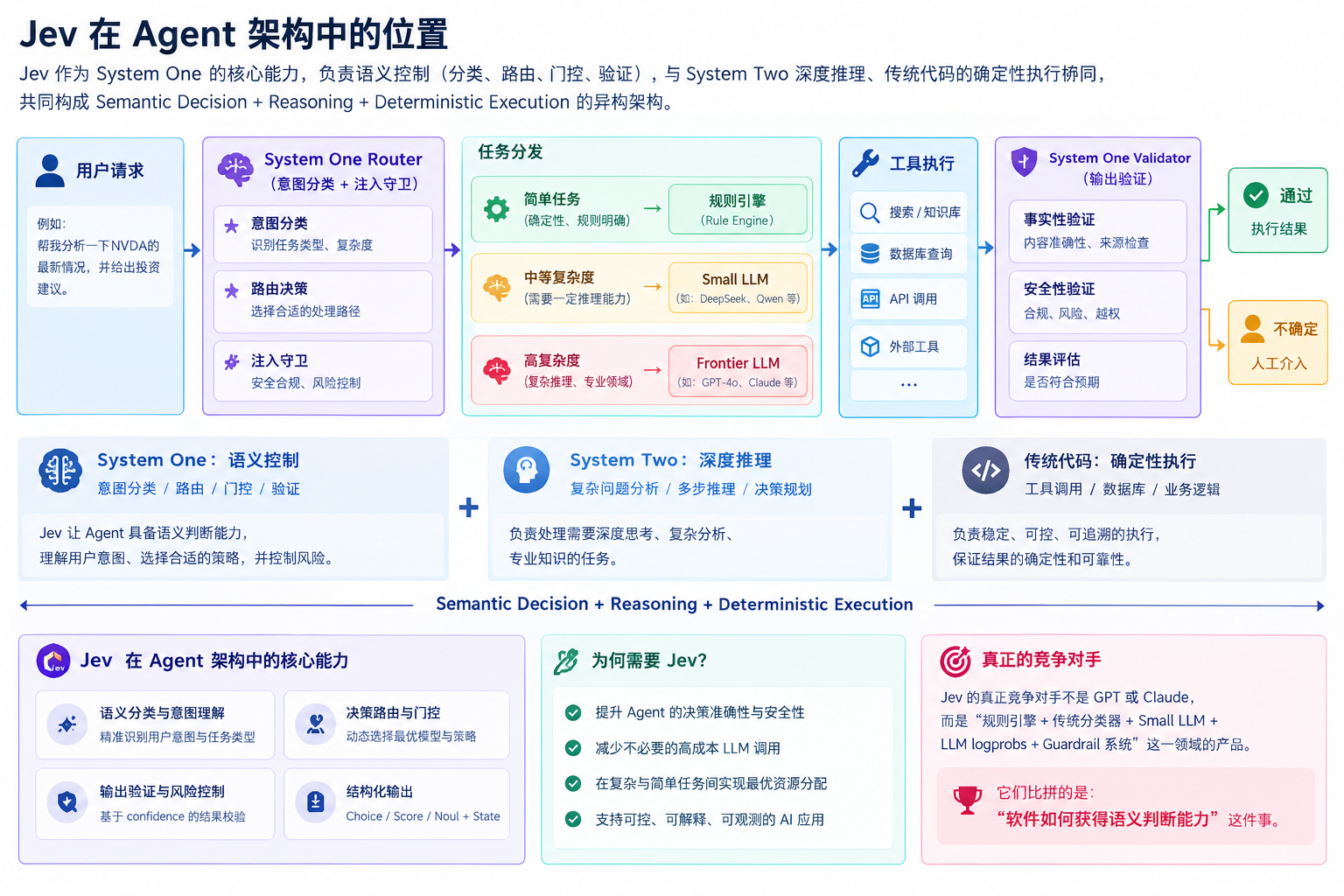
System One handles semantic control (classification, routing, gating, validation). System Two handles deep reasoning. Traditional code handles deterministic execution. Together they form a heterogeneous architecture: Semantic Decision + Reasoning + Deterministic Execution.
So Jev’s real competitors aren’t GPT or Claude—they’re products in the space of “rules engines + traditional classifiers + Small LLMs + LLM logprobs + guardrail systems.” What they’re competing on is “how does software get semantic judgment capability.”
On cost, what matters isn’t the per-million-token price but the total cost per completed business task:
1 | TCO_task = C_model + C_network + C_parse_retry |
Model call cost is often the smallest component. At the official input price of $0.042 / 1M tokens, if each request is 300 input tokens, the model cost per thousand tasks is about 1000 × 300 × 0.042 / 10⁶ ≈ $0.013. By comparison, reducing human escalation rate by 1 percentage point or reducing mis-execution rate by 0.1 percentage points typically has a much bigger impact on TCO. This reinforces that what determines Jev’s business value is calibration and accuracy, not unit price.
There’s also an easily overlooked detail: in Choice scenarios, option descriptions themselves are input tokens. 16 options at 15 tokens each is 240 tokens, possibly longer than the user message. More detailed descriptions improve discrimination but increase cost—it’s a parameter you need to balance.
10. Migrating from LLM to Jev: A Code Comparison
Before migration, a typical LLM + JSON ticket classifier:
1 | import json |
After migration:
1 | from typesafe_sdk import Choice, Noul, TypeSafeClient |
What disappears after migration: format instructions in the prompt, JSON extraction, schema validation, retry loops, model self-reported confidence. What’s added: fallback option, injection guard, per-class derived thresholds, question definition versioning. So code volume might not decrease much—it might even increase—but every line has a clearer responsibility.
11. Selection: When to Use Jev
| Approach | Needs labeled training data | Can define task at runtime | Probability usability | Best for |
|---|---|---|---|---|
| Rules / regex | No | Change code | None | Clear format, clear boundaries |
| Fine-tuned small classifier (DeBERTa, ModernBERT, etc.) | Hundreds per class | No | Needs self-calibration | Stable labels, huge call volume |
| Embedding + logistic regression | Tens per class | Fast to retrain | Needs calibration, LR itself is relatively good | Cold start, fast iteration |
| Jev-type Decision Model | No (but evaluation set still needed) | Yes | Official emphasis on calibration | Labels change often, multi-dimensional judgment, multi-tenant custom tasks |
| LLM single-token logprobs | No | Yes | Needs temperature scaling | Existing LLM stack, high semantic difficulty |
| LLM generates JSON | No | Yes | Self-reported confidence usually unreliable | Explanations or content generation needed |
A rough decision order:
- If rules can express it clearly → use rules
- If labels are stable, you have data, and call volume is massive → fine-tune a small classifier; lowest long-term cost
- If labels change often, tasks are defined at runtime by operations or customers, and you need to judge multiple dimensions at once → this is where Jev shines
- If you need text output or reasoning process → LLM
Note: not needing training data doesn’t mean not needing labeled data. Without an evaluation set, you can’t measure calibration, so you can’t derive thresholds. Decision Models save you the training set, not the evaluation set. So engineering-grade evaluation capability isn’t something you can skip—your engineering team still needs to build it.
12. Reproducible Evaluation: How to Verify Jev Yourself
12.1 Experiment Design
- Dataset: CLINC150 (
clinc_oos, plus config) bank domain with 15 intents, plus 150 out-of-scope samples as theoosclass. I chose it because it comes with out-of-distribution samples, perfect for testing the closed-set problem; 16 options is also within Choice’s reasonable range - Chinese: official docs don’t cover multilingual performance. I’d suggest manually annotating 200–300 Chinese tickets and running the same experiment
- Comparison approaches: Jev (without
oosoption); small LLM single-token logprobs (raw / temperature-scaled); small LLM generates JSON (self-reported confidence); fine-tuned small classifier; embedding + logistic regression - Metrics: Accuracy, Macro-F1, top-label ECE (based on peak), ECE (based on confidence field), Brier, NLL, end-to-end P50 / P95 latency, cost per thousand tasks, OOS high-confidence misclassification rate (proportion of OOS samples assigned to some intent with peak ≥ 0.9)
12.2 Results Recording Template
| Approach | Acc | Macro-F1 | ECE (peak) | ECE (confidence field) | Brier | P50 / P95 | $ / 1k tasks | OOS high-conf misclassification |
|---|---|---|---|---|---|---|---|---|
| Jev | TBD | TBD | TBD | TBD | TBD | TBD | TBD | TBD |
| Jev (no oos option) | — | — | — | — | — | — | — | TBD |
| Small LLM logprobs (raw) | TBD | TBD | TBD | — | TBD | TBD | TBD | TBD |
| Small LLM logprobs (temperature-scaled) | TBD | TBD | TBD | — | TBD | TBD | TBD | TBD |
| Small LLM JSON (self-reported confidence) | TBD | TBD | TBD | — | — | TBD | TBD | TBD |
| Fine-tuned small classifier | TBD | TBD | TBD | — | TBD | TBD | TBD | TBD |
| Embedding + LR | TBD | TBD | TBD | — | TBD | TBD | TBD | TBD |
12.3 How to Interpret Results
- Jev’s ECE (peak) vs temperature-scaled LLM baseline: if significantly lower, calibration is the real differentiator; if similar, Jev’s value converges to “no-maintenance calibration + low latency + multi-question parallelism”
- Gap between ECE (confidence field) and ECE (peak): expect the former to be significantly worse, systematically biased above the diagonal on the reliability diagram. This confirms “confidence field can’t be used as accuracy”
- OOS high-confidence misclassification rate with and without fallback option: this number directly quantifies the cost of label space design errors and is the best evidence for convincing your team that
otheris mandatory - P95 latency and per-thousand-task cost vs fine-tuned small classifier: if the fine-tuned model has similar accuracy but an order of magnitude lower cost, Jev’s positioning is “for the tasks where labels change,” not all classification tasks
- If Jev’s own ECE isn’t great: you can still apply temperature scaling to log(P) before using it
13. Official Performance Data and Correct Interpretation
- Latency around 70ms to 500ms, input price $0.042 / 1M tokens
- Within 24 hours of launching on Vercel AI Gateway, nearly 13% of paying teams started using it, making it the fastest-adopted model on the platform
- Independent testers observed 193× speed improvement and 444× cost reduction on specific tasks
- On TypeSafe’s own benchmark, Jev accuracy is 67.8%, GPT-5.6 Terra is 67.9%, GPT-5.6 Sol is 74.1%
API latency ≠ end-to-end latency. Real requests go through gateway, network, agent framework, tool calls, and database. 70ms model latency doesn’t mean 70ms system response. You should measure end-to-end P50 / P95 / P99.
67.8% as an absolute number doesn’t tell you production readiness. The strongest comparison model only hits 74.1%, which means either the benchmark itself is hard or the ground truth has noise. What matters is the relative position: Jev is on par with GPT-5.6 Terra, about 6 percentage points behind Sol, while latency and cost are one to two orders of magnitude lower. What accuracy you’ll get on your business tasks—you can only measure that on your own data.
14. Production Prerequisites: Security, Compliance, and Operations
This applies to any automated decision system. Here I’ll just list the points most relevant to Decision Models:
| Capability | Key Requirements |
|---|---|
| Audit logs | Record State summary, question version, full distribution, threshold, final action, model and SDK version |
| Version pinning | Model, question definitions, and thresholds versioned separately; recalibration required after model upgrades |
| Drift monitoring | Input distribution, probability distribution, ECE, human escalation rate; alert or rollback when ECE exceeds threshold |
| Shadow deployment | New model or new question definitions log only, don’t execute, compared against production decisions |
| Input security | Distinguish trusted vs untrusted fields, prevent decision boundary injection, PII minimization and masking |
| Deployment model | Financial, healthcare, government scenarios typically need VPC or dedicated instances [unverified: official support status] |
| Human fallback | Low probability, high risk, suspected out-of-distribution, suspected injection must all be able to escalate to human |
| Compliance | Automated decisions need to provide explanation, appeal, and human review channels (GDPR, EU AI Act, etc.), plus periodic fairness assessment by group |
15. Personal Assessment and Conclusion
What’s most worth watching about Jev isn’t the 70ms latency or the $0.042 / 1M tokens price—those numbers will eventually be caught. What’s really worth watching is: TypeSafe is trying to redefine language models as a kind of Decision Model that software can call directly:
1 | Before: AI = Generate Text Interface: Prompt → Tokens |
Jev’s core contribution isn’t just the model itself—it’s also an engineering methodology for judgment-based AI: three primitives, probability-driven routing, speculative fan-out and composite scoring. The value of this methodology is independent of Jev as a specific model. This article adds three things that were previously missing: the confidence field can’t be used as accuracy; thresholds should be derived from misjudgment cost; calibration can and should be verified on your own data.
The three questions most worth watching next:
- Can calibration become an independent advantage? When compared against a temperature-scaled LLM logprobs baseline, can Jev achieve comparable accuracy, significantly better calibration, and significantly lower latency?
- Can it form an ecosystem? Can Decision Models form a complete pipeline with agent frameworks, observability, evaluation tools, human review, and workflow engines?
- Will
/decisionbecome a standard API? If future model APIs provide Generate, Reason, and Decide modes simultaneously, what Jev is doing today would be a paradigm shift in API abstraction.
Until these questions get public experiments and independent verification, I prefer to see Jev as a very interesting technical direction rather than a proven new paradigm. For engineers, the most practical approach is to pick a real routing or gating scenario, run the scripts in this article on your own data, look at calibration, end-to-end latency, TCO, and OOS performance, then decide whether to bring it into production.
Appendix B: References
- TypeSafe AI official blog: Introducing System One Models & Jev
- TypeSafe docs: Primitives (Choice / Score / Noul)
- TypeSafe docs: Choice Primitive
- TypeSafe docs: Models and Pricing
- DCVC-led seed funding announcement
- Vercel AI Gateway: Jev adoption data announcement
- Independent testing: Jev speed and cost tests (193× / 444×)
- CLINC150 dataset: Larson et al., An Evaluation Dataset for Intent Classification and Out-of-Scope Prediction, EMNLP 2019
- Temperature scaling: Guo et al., On Calibration of Modern Neural Networks, ICML 2017